
Airline pilot training, in detail
Discover the full Astonfly pathway: 24 months full-time, 100% in English, to learn the theory, build up your flying and prepare for airline standards.
ApplyTwo programmes, one shared foundation
At Astonfly, the Ryanair Future Flyer Academy and Multi Airlines programmes share the same 24-month training foundation: theory, practical flying, ratings and preparation for crew work. The difference lies in the career goal and the support after training.
Ryanair Future Flyer Academy
For candidates who want to aim for Ryanair from the outset, with an airline-focused path and a conditional job offer before training.
- Ryanair goal
- Conditional job offer
- Targeted airline path
Multi Airlines
For candidates who want to keep several options open and prepare for the selections of different airlines after their training.
- Airline of your choice
- Preparation for selections
- Career support
Your 24-month journey
Over 24 months you progress step by step: you start by learning the fundamentals of the job, then move on to practical flying and simulator work. By the end of the course, you are ready for the next stage of your path according to the programme chosen: Ryanair Future Flyer Academy or Multi Airlines.
- Theory phase · 9 months
Learn the fundamentals through theory
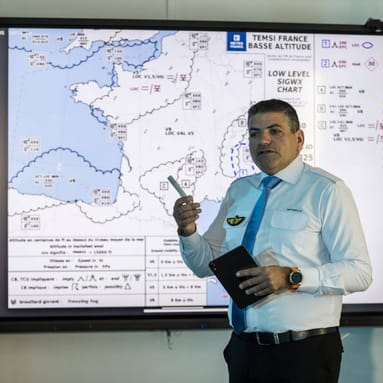
You start by understanding what a pilot must know before flying in a professional environment: weather, navigation, rules of the air, flight preparation, safety, communication and how the aircraft works.
- 9 months of classes
- 13 ATPL exams
- Fundamentals
- Practical phase · 15 months
Learn to fly, step by step
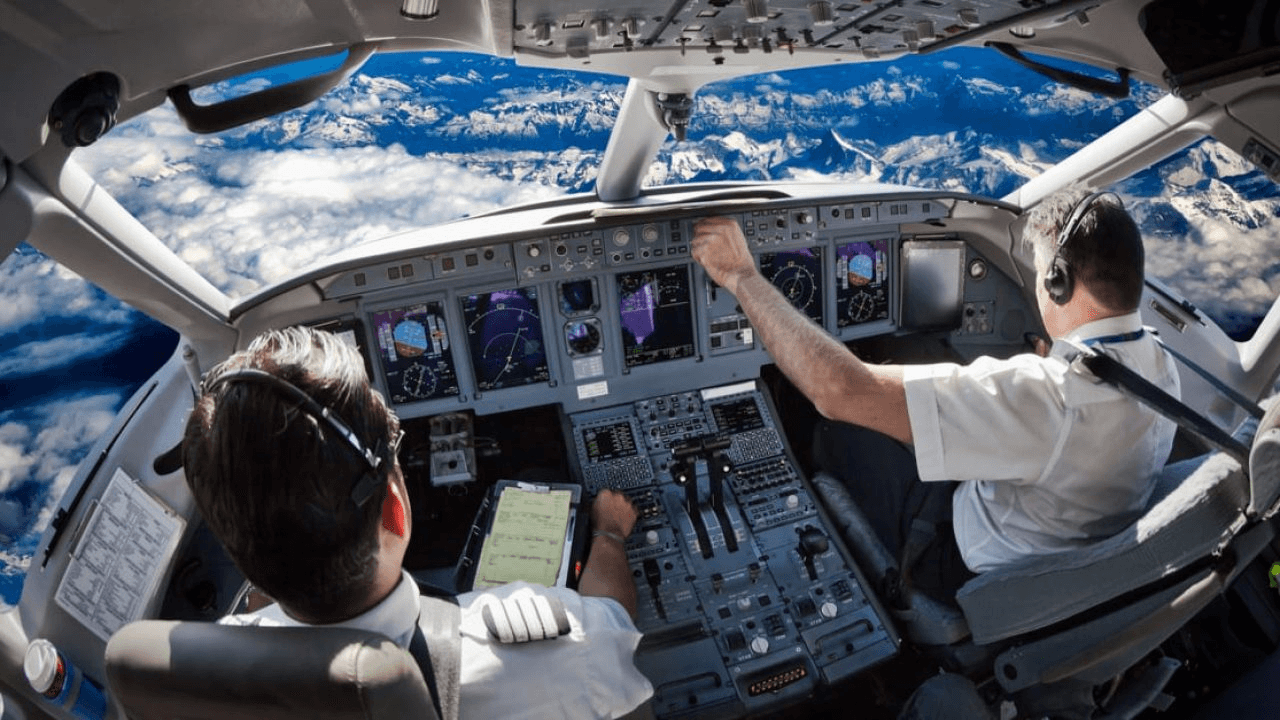
You learn to fly step by step: first your early flights and navigation, then more advanced flying such as night flight, instrument flight and multi-engine. You then continue on the simulator to work on safety, decision-making and two-pilot teamwork, just like in an airline cockpit.
- 15 months of practical flying
- Flying + simulator
- Step-by-step progression
- Next steps
Prepare the next stage according to your programme
At the end of the course, what comes next depends on the programme chosen. With Ryanair Future Flyer Academy, you follow a Ryanair-focused path. With Multi Airlines, you prepare for the selections of several airlines.
- Ryanair FFA
- Multi Airlines
- Airline selections
9 months to master airline pilot theory
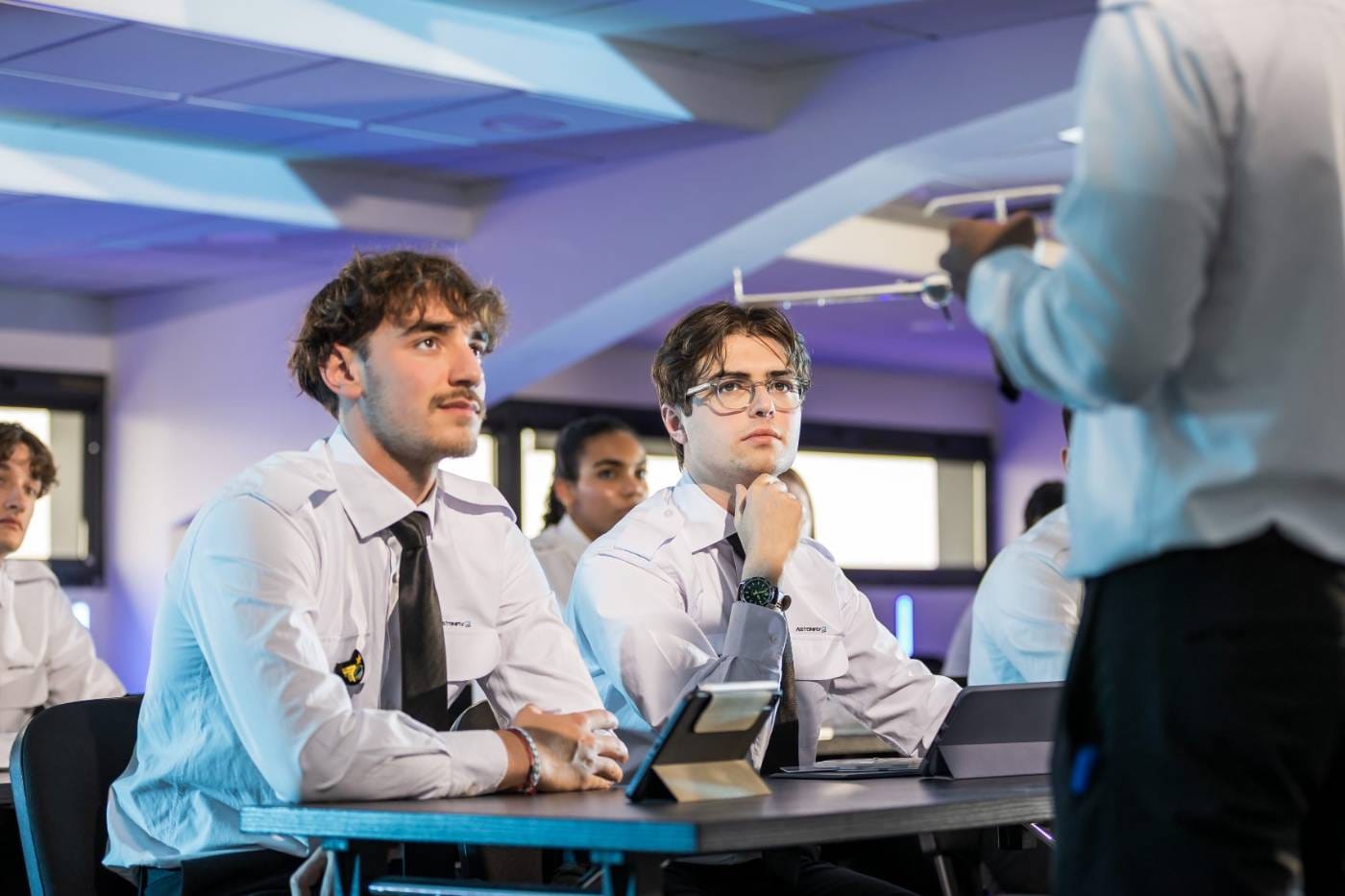
After an induction week, you follow 9 months of theory, in English, to acquire all the fundamentals of the job. This knowledge is split across 13 ATPL exams + 100 KSA, grouped here into 3 main areas.
Airframe & systems
021Understand the aircraft’s structure and its main systems.
Instrumentation
022Understand the cockpit instruments and displays.
Radio navigation
062Guide yourself using radio instruments and navigation aids.
Communications
090Use radio communications with air traffic control services.
Mass & balance
031Calculate the aircraft’s balance and load distribution.
Performance
032Calculate the aircraft’s capabilities based on weather, mass and runway.
Flight planning
033Plan a flight from A to Z.
Meteorology
050Understand and anticipate weather conditions.
Principles of flight
081Understand why and how an aircraft flies.
Air law
010Understand the rules that govern aviation and air traffic control procedures.
Human performance
040Understand fatigue, stress, decision-making and physiology.
General navigation
061Find your position, calculate your route and prepare your navigation.
Operational procedures
070Understand the procedures used in operations.
Knowledge, skills and attitudes100 KSA
The 100 KSA (Knowledge, Skills and Attitudes) assesses, alongside the written exams, your ability to apply what you know as a professional pilot.
Aviation EnglishFCL.055
One week is dedicated to Aviation English training and the exam. The required level allows you to communicate in English in a professional aviation context.
15 months to learn to fly
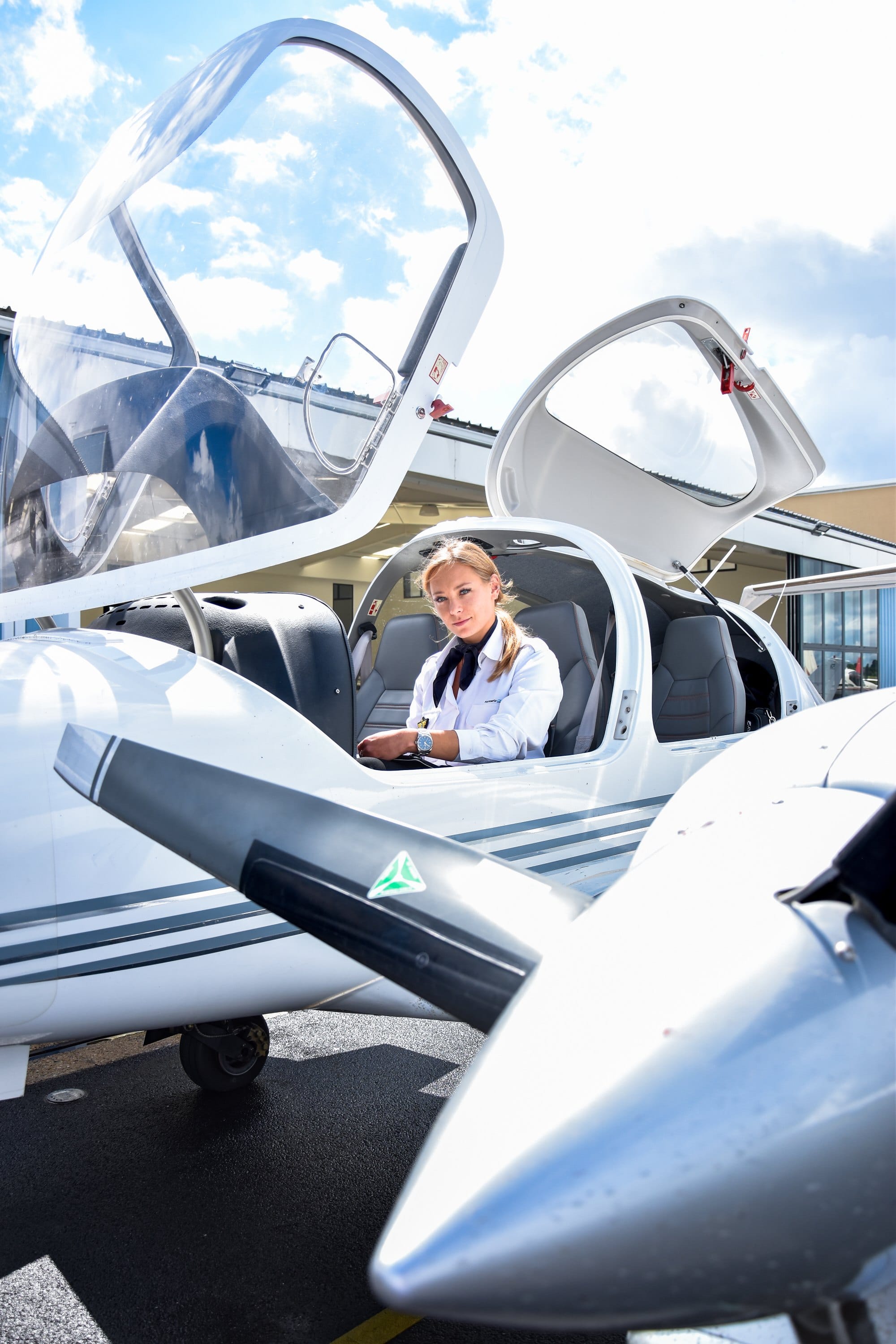
The practical training is organised into 5 progressive blocks, delivered entirely in English: basic flying, navigation, night flight, instrument flight and multi-engine, then advanced preparation on the simulator. Each block builds the skills expected of a future professional pilot.
Your first flight hours
- 17 weeks
- Paris-Saclay-Versailles
You discover flying alongside an instructor, then progress to your first solo flight.
What you achieve: your first flight hours and your first solo flight.
See the hours breakdown
- Cessna 172S
- 22h with instructor · 10h solo
- Simulator
- 5h with instructor
You discover the Cessna 172S, its Garmin G1000 cockpit, the basics of flying and your first solo flights.
Becoming a professional pilot
- 19 weeks
- Paris-Saclay-Versailles
You progress in navigation, fly at night and start flying more complex aircraft.
What you validate: the commercial pilot licence and the multi-engine rating.
See the hours breakdown
- Cessna 172S
- 30h with instructor · 9h solo
- Diamond DA42
- 17h with instructor
- Simulator
- 5h with instructor
This block prepares you for night flying, long-distance navigation and your first flights on a multi-engine aircraft.
Flying on instruments
- 20 weeks
- Paris-Saclay-Versailles
You learn to fly mainly with the cockpit instruments, particularly when outside visibility is reduced.
What you validate: the instrument flight rating.
See the hours breakdown
- Cessna 172S
- 45h with instructor
- Diamond DA42
- 15h with instructor
- Simulator
- 20h with instructor
This block is dedicated to instrument flight, radio navigation and preparation for the IR ME practical test.
Regaining control
- 1 week
- Le Castellet
You learn to recognise and recover from certain unusual flight situations.
What you validate: the UPRT certificate.
See the hours breakdown
- Mudry CAP 10
- 3h with instructor
This block combines a theory part and a practical part on the Mudry CAP 10, to build the right reflexes in an unusual situation.
Flying as a two-pilot crew
- 3 weeks
- Dublin
- Berlin
On the simulator, you learn to work as a crew: communication, role sharing, decision-making and managing a two-pilot flight.
What you validate: the APS MCC certificate.
See the hours breakdown
- Simulator
- 40h with instructor
This block takes place at a simulation centre in Dublin or Berlin. It prepares you for crew work in a multi-pilot environment.
The last practical stage before continuing with the Ryanair FFA or Multi Airlines programme.
A method designed to learn more effectively
Students learn in the air, on the simulator and through active observation, in a setting close to professional requirements.
Learning in pairs
Two students and an instructor on board to progress together, share feedback and build crew-work reflexes.
Garmin G1000
A modern glass cockpit to get familiar from the very first hours with the displays, flight parameters and integrated navigation.
Backseat
While one student flies, the other observes from the back seat, listens to the exchanges with the instructor and analyses the flight decisions.
A modern fleet to learn as in a professional environment
Students train on a homogeneous fleet, equipped with Garmin G1000, and on simulators used to prepare the advanced stages of the course. The aim: to learn from the start in an environment close to professional standards.
24 aircraft+ 5 simulators
The aircraft fleet
- Single-engine15 aircraft
Cessna 172S G1000
The most common aircraft in the fleet: basic flying, navigation and solo flights.
See details — Cessna 172S G1000 - Multi-engine8 aircraft
Diamond DA42 G1000
The fleet’s twin-engine: instrument flight, radio navigation and multi-engine ratings.
See details — Diamond DA42 G1000 - Aerobatics1 aircraft
Mudry Cap 10
The aircraft dedicated to advanced safety: recognising and recovering from unusual attitudes.
See details — Mudry Cap 10
The simulators
ALSIM AL250
FNPT II (3 simulators)
The tool for procedures and instrument flight, in single- or multi-engine configuration.
See details — ALSIM AL250
BOEING 737
FNPT II - MCC (2 simulators)
The airliner cockpit: crew work and multi-pilot procedures in APS MCC.
See details — BOEING 737
You build your airline pilot profile
Astonfly training lets you complete the major milestones needed to target an airline: airline pilot theory, a professional licence, instrument flight, multi-engine, advanced safety, Aviation English and crew teamwork.
- ATPL theory
The airline pilot theory exams
The ATPL theory exams cover the profession’s reference knowledge: navigation, meteorology, regulations, performance, human factors and communications.
- FCL.055
Prove your Aviation English level
This assessment validates the pilot’s ability to communicate in English in an operational context, notably with air traffic control.
- CPL(A)
The commercial pilot licence
This is the licence that lets you work as a professional aeroplane pilot, with the necessary associated ratings.
- IR ME
Fly on instruments
This rating lets you fly a multi-engine aircraft using only the cockpit instruments, particularly when outside visibility is reduced.
- MEP
Fly a piston multi-engine aircraft
This rating teaches you to fly an aircraft with several piston engines. It isn’t directly required by airlines, but it is needed to follow multi-engine instrument training and obtain the IR ME rating.
- UPRT
Handle unusual situations
This module prepares the pilot to recognise, prevent and recover from unusual flight situations, such as a loss of control or an abnormal aircraft attitude.
- APS / MCC
Learn to work as a crew
This training prepares you for two-pilot cockpit work, with communication, task sharing and decision-making.
A demanding course, with close supervision
The training takes commitment, but students are never on their own: they are monitored, supervised and supported at every stage.
Full-time
An intensive pace, Monday to Saturday, to progress fast.
100% in English
You're ready from the start for international airlines, where English is the norm.
Pair training
Two students and one instructor per flight: you also learn by observing, as in a crew.
Experienced instructors
Our instructors are also active airline pilots. You learn from those who live the job.
Individual follow-up
Personalised support, so no one falls behind.