
How to become an airline pilot?
Requirements, studies, licences, training, duration and opportunities: the complete guide to understanding how to reach the cockpit of an airline.
The journey at a glance
To become an airline pilot, you need to meet the prerequisites, choose a training route, pass the selections, obtain the required licences and ratings, then join an airline as a First Officer.
Meet the prerequisites
Level of education, medical fitness, English and motivation.
Choose a training route
Private school, public route, cadet, modular or career change.
Pass the selections
Motivation, logic, English and aptitude for training.
Obtain the licences
Theory and practice up to the required ratings.
Join an airline
As a first officer, then progression to captain.
What are the requirements to become an airline pilot?
You don't need any prior flying experience to start an integrated course. However, certain prerequisites are essential: a sufficient level of education, a Class 1 medical certificate, a good level of English, strong motivation and the ability to follow a demanding programme.
Age
Depending on the route, entry to training can be possible from age 17.
Level of education
A baccalaureate or equivalent is generally required.
Medical fitness
The Class 1 medical certificate is essential to work as a professional pilot.
Learn moreEnglish
English is the international language of aviation.
Study / work rights
Conditions vary by country, licence and target airline.
Criminal record
Some airlines or programmes may require a clean criminal record.
What should you study to become an airline pilot?
There is no single route to becoming an airline pilot. Some candidates go through a private flight school, others through a selective public programme, a cadet scheme, a modular course or a career change. A scientific background can help, but success rests above all on method, consistency, English and motivation.
Which A-levels to choose?
A general academic track with a scientific foundation is an advantage, but it is not the only possible path. What matters most is having the grounding needed to follow the training, pass the selections and keep up the pace.
Which route should you choose to become an airline pilot?
Several routes lead to the cockpit. They differ in pace, entry requirements, funding, selectivity and the level of support provided.
- Continuous path
Full-time integrated course
A structured path, also called ATP integrated training, that brings together all the steps needed to obtain the professional licence and associated ratings, in a continuous full-time programme.
- Step by step
Modular course
A more gradual path, letting you progress module by module (licence and ratings) at your own pace, budget and availability.
- Airline-linked
Funded cadet programme
A highly selective path, run in direct partnership with an airline, which sets the selection criteria, content and recruitment goals. Usually funded by the airline, it can lead to an MPL licence, designed specifically to prepare pilots for its operational environment.
- By competitive exam
Public training
A highly selective route, accessible by competitive exam and funded by a public body. Places are limited and admission conditions are specific to each institution.
In Europe, most pilots now train at private schools, funding all or part of their course directly or through a loan. Programmes funded by an airline or a public body do exist, but they offer far fewer places and rely on specific selection processes.
Can you become a pilot after a first career?
What about career changers?
It is possible to become an airline pilot after studying or a first career. A career change is not a training route in itself: it can go through a full-time or a modular course, depending on the time available, funding, level of English, medical fitness and career plan. There is no single starting age, but age should be weighed against the length of the course, airlines' recruitment criteria and the number of career years possible after training. A Class 1 medical examination is therefore an essential step before committing.
The steps to become an airline pilot
The path varies with the route chosen, but it generally follows the same main stages: check the prerequisites, choose a course, obtain the licences and pass the airline selections.
Typical duration: 18 to 28 months on an integrated course
A day in training
Behind the scenes with a student.
- Prerequisites
Check the prerequisites
Age, level of education, English, medical fitness, study or work rights: the first step is to check that your profile fits the route you're aiming for.
- Training
Choose your training route
Private school (full-time integrated or modular), public training, funded cadet programme: each route has its advantages, constraints and level of selectivity.
- Selection
Take the selections
Selections generally assess motivation, reasoning, English, logic, basic knowledge and the aptitude to follow a demanding course.
- Theory
Follow the theory training
The theory builds the essential foundations: regulations, navigation, meteorology, performance, human factors, operational procedures and communications.
- Practical
Train in the air
Practical training teaches you to fly, navigate, manage procedures, fly at night, progress towards instrument flight and build operational reflexes.
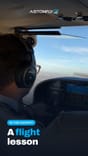 Reel · coming soon
A flying lesson in the cockpit
At the controls with a student pilot.
- Licences & ratings
Obtain the required licences, ratings and certificates
Depending on the route, the candidate passes the ATPL theory exams, the CPL(A) licence, the instrument and multi-engine ratings, plus additional modules such as UPRT, APS/MCC and the FCL.055 language proficiency.
Target licence & ratings
- ATPL Theory certificatesThe 13 exams + 100 KSA, the theory reference of the airline pilot path.
- CPL(A)The commercial aeroplane pilot licence.
- IR MEFlying on instruments, without visibility, on a multi-engine aircraft.
- UPRTTraining to recognise, prevent and recover from an unusual flight situation.
- APS MCCTraining to work as a two-pilot crew, as in an airline.
- Recruitment
Pass the airline selections
Once trained, the candidate must pass airlines' recruitment processes: interviews, tests, English, simulator and assessment of crew work.
- Airline
Join an airline as a first officer
The first line role is usually first officer. With experience, the pilot can then progress to captain.
Licences, ratings, exams: what do you need to obtain to become an airline pilot?
Becoming an airline pilot takes more than "knowing how to fly". The path includes theoretical exams, a professional licence, flight ratings and additional modules that gradually prepare you for the airline environment. In Europe, this path sits within the EASA regulatory framework.
- ATPL theory
The airline pilot's knowledge
The 13 theory exams (+ 100 KSA) cover the essential subjects: regulations, navigation, weather, performance, human factors, flight preparation and communications.
- FCL.055
Prove your Aviation English level
This assessment validates the pilot's ability to communicate in English in an operational context, notably with air traffic control.
- CPL(A)
The commercial pilot licence
This is the licence that lets you work as a professional aeroplane pilot, with the necessary associated ratings.
- MEP
Fly a piston multi-engine aircraft
This rating teaches you to fly an aircraft with several piston engines. It isn't directly required by airlines, but it is needed to follow multi-engine instrument training and obtain the IR ME rating.
- IR ME
Fly on instruments
This rating lets you fly a multi-engine aircraft using only the cockpit instruments, particularly when outside visibility is reduced.
- UPRT
Handle unusual situations
This module prepares the pilot to recognise, prevent and recover from unusual flight situations, such as a loss of control or an abnormal aircraft attitude.
- APS / MCC
Learn to work as a crew
This training prepares you for two-pilot cockpit work, with communication, task sharing and decision-making.
For a detailed look at the European framework, see our guide to the EASA licence.
How long does it take to become an airline pilot?
The duration depends on the route chosen and the school. A full-time integrated course can allow you to complete the whole programme in around 18 to 28 months, while a modular course can spread over a longer period depending on the candidate's pace.
- Continuous path
18–28months
Full-time integrated course
A complete, continuous programme, from theory to airline preparation.
- Step by step
Variable
Modular course
Progress licence by licence, spread out at the candidate's pace and usually without preparation for airline selections.

24 months full-time — an integrated course, from theory to preparation for airline selections.
How to fund your airline pilot training?
Airline pilot training is a major investment. The cost depends on the country, the school, the route chosen, flight hours, simulators, exams and the ratings included. It is therefore essential to plan the funding from the very start of the project.
Student or training loan
Some banks offer solutions dedicated to long vocational courses.
Instalment payment
Some schools let you pay in instalments according to the stages of the course.
Professional funding schemes
Depending on your profile, certain schemes may be available for a career change or vocational training.
At Astonfly, several options can be considered to help fund your training: a banking partnership, instalment payment and support in putting together your application, within the framework of our Qualiopi certification. See funding options
How does an airline selection usually work?
Each airline sets its own recruitment process according to its needs, fleet and internal criteria. The steps can therefore vary, but a typical selection usually includes several successive assessments.
Application screening
Review of the background, licences, ratings and how well the profile fits the airline's prerequisites.
Online tests
Aptitude tests, logic, technical knowledge, English and sometimes personality tests.
HR and technical interview
Presenting your project, motivation and background, with technical and operational questions.
Simulator assessment
A scenario to observe flying, method, communication and crew work.
At Astonfly, the Multi Airlines programme prepares students for the main stages of airline selection and supports them in building their application and career plan.

Becoming an airline pilot with Astonfly
Astonfly offers two integrated 24-month paths depending on your goal: join Ryanair via the Future Flyer Academy, or prepare for the selections of several airlines with the Multi Airlines programme.
- 24-month integrated course
- Campus 20 minutes from Paris
- Modern fleet and simulators
- Preparation for airline selections
- Astonjob access • Pilot jobs & alumni network
- 96% hired within 12 months — Multi Airlines
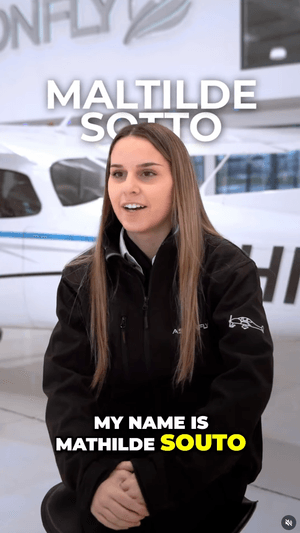
Why I chose Astonfly
Mathilde Souto, student pilot
Common myths about the airline pilot profession
Many clichés discourage people who would be a great fit for the cockpit. Let's set the record straight.
- Myth
« You have to be a maths genius »
The realityA good level is enough: consistency and method matter more than a gift for calculation.
- Myth
« You need perfect eyesight »
The realityCorrection is allowed within certain limits — vision is simply checked at the Class 1 medical.
- Myth
« You must have flown before »
The realityNo: the integrated course starts from scratch. No flying experience is required to begin.
- Myth
« It's a job for men only »
The realityFalse. The profession is open to all. Airlines look above all for candidates who are motivated, rigorous and able to work as a crew.
- Myth
« It's too late after 25-30 »
The realityCareer changes are common and valued by airlines: you can start later, after other studies or a first career.
- Myth
« The autopilot does everything »
The realityNo: the pilot remains the decision-maker at all times. Automation is an aid, never a replacement.
What really matters — motivation, rigour and dedication count as much as your academic record. The rest can be learned.
Ready to get started?
It all starts with a first conversation with our team.
Going further
The airline pilot profession
Missions, a typical day, roles and cockpit qualities.
Learn moreAirline pilot salary
Pay, progression and the difference between first officer and captain.
Learn moreThe EASA licence
The European framework, the licences, the ratings and the equivalences.
Learn moreMarket & recruitment
A sector in high demand and the job prospects.
Learn moreEmployability
The employability results of Astonfly students.
Learn moreOur programmes
One training track for two programmes.
Learn more