


Recognised standards.
A framework that protects your training.
Choosing a flight school also means checking the recognition of its training, the quality of its organisation and the clarity of its commitments. Astonfly operates within a regulated, audited framework designed to guarantee the seriousness of your journey.
Approval, certification, maintenance and commitment: four complementary roles
These four frameworks don’t cover the same things. The EASA ATO approval authorises and governs the training: programmes, instructors, exams and teaching resources. Qualiopi certification assesses the organisation of the training, the information given to the public and the support of students. The PART-CAO approval governs the technical and regulatory upkeep of the aircraft used for flying. The SNPL ethical charter formalises, on a voluntary basis, commitments to transparency towards future pilots.
EASA ATO approval
Authorising and governing the training
The DGAC issues the ATO approval and checks compliance with the European regulatory framework defined by EASA: programmes, instructors, exams and teaching resources.
Qualiopi certification
Assessing the quality of the processes
Qualiopi covers the organisation of the training, the information given to the public, the support of students and the resources deployed.
PART-CAO approval
Maintaining the fleet
The maintenance workshop handles the technical and regulatory upkeep of the aircraft used for training, close to the school's operations.
SNPL ethical charter
Formalising commitments to transparency
This voluntary charter sets out principles intended to give a clearer framework to the relationship between the school and its future students.
These frameworks are complementary: none replaces the others.
Astonfly is an EASA-certified ATO
FR.ATO.0036
An ATO — Approved Training Organisation — is an organisation authorised to deliver aviation training within its scope of approval. Astonfly’s approval is granted by the French Civil Aviation Authority (DGAC), within the European regulatory framework defined by EASA — the European Union Aviation Safety Agency.
It governs, among other things, the programmes concerned, the instructors, the exams, the teaching resources and the tracking of students’ progress.
For a future pilot, this framework allows you to obtain European licences and ratings and to consider a career with operators who recognise them, subject to their own recruitment criteria and right-to-work rules.
Main titles and ratings in the course
- ATPL theory
- FCL.055
- CPL
- MEP
- IR ME
- UPRT
- APS MCC
The recognition or conversion of a licence outside the EASA scope depends on the rules of the authority and country concerned.

What this means for you
- Qualified instructors
- Approved programme
- Monitored fleet and simulators
- Documented progress
- Recognised qualifications
Astonfly is Qualiopi-certified
Qualiopi certification attests to the quality of the processes implemented by the training organisation against the National Quality Standard. It covers, in particular, information for the public, learning objectives, support, resources and continuous improvement.

Clear information
Services, entry conditions and results communicated in a structured way.
Objectives and support
Defined objectives and support suited to how the training unfolds.
Teaching resources
Teams, equipment and resources consistent with the training delivered.
Continuous improvement
Assessments, feedback and complaints taken into account as the organisation evolves.
Qualiopi does not replace the ATO aviation approval. It may give access to certain public or pooled funding depending on the candidate’s status, the scheme concerned and the acceptance of the application.
Astontec, a PART-CAO approved maintenance centre
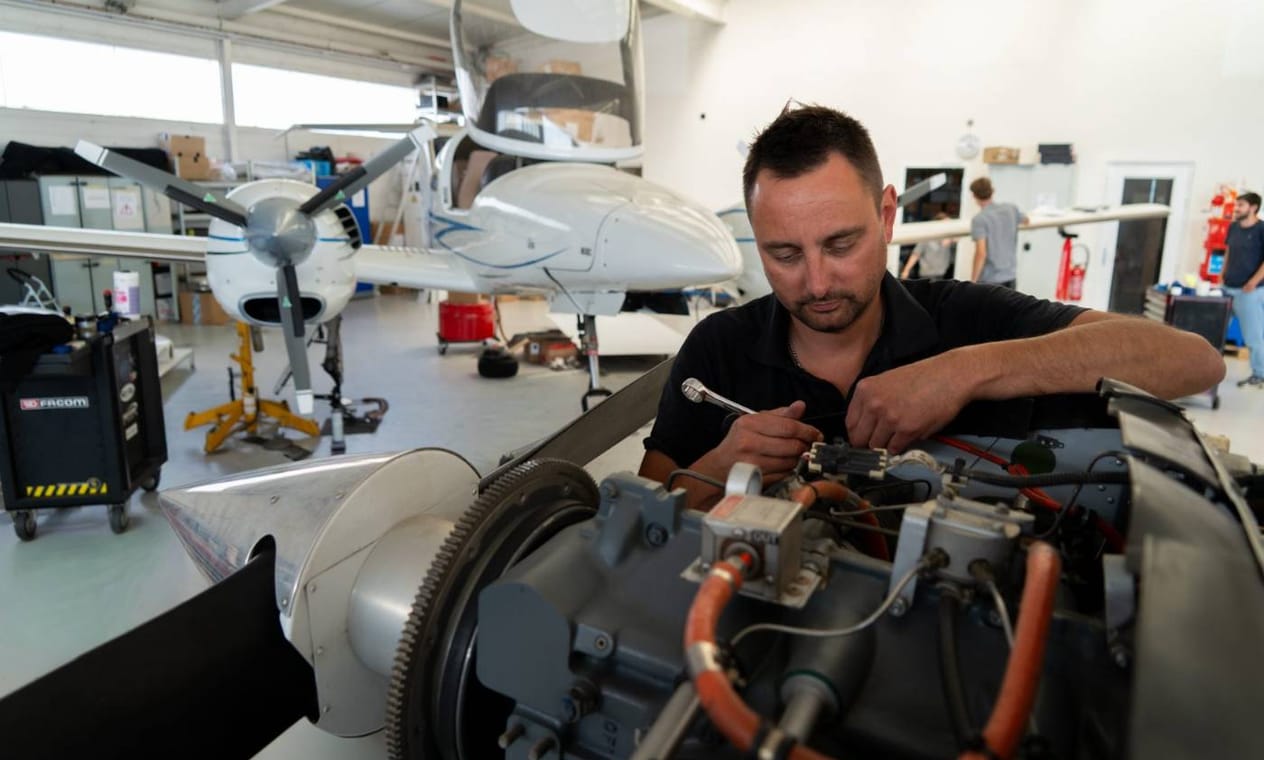
Practical training relies on aircraft that are available, monitored and maintained to the applicable requirements. Astonfly relies on Astontec, its dedicated maintenance centre, approved PART-CAO — Combined Airworthiness Organisation — a European approval that allows a single organisation to manage both continuing airworthiness and maintenance of the aircraft.
This framework governs each aircraft’s maintenance programme, the tracking of due dates and the associated documentation. The technical teams work close to the school’s operations: scheduled maintenance, handling of technical work and tracking of the aircraft used by students and their instructors.


Planned maintenance
Maintenance operations are organised according to the programmes and deadlines applicable to the aircraft.
Close to operations
The proximity between the school and the workshop makes exchanges easier between the teaching, operations and technical teams.
Knowledge of the fleet
Regular monitoring of the aircraft allows the technical teams to know the aeroplanes used in training well.
Expertise recognised by the manufacturers
Astontec is listed by the manufacturers of the fleet’s aircraft: an authorised Cessna facility for piston single-engines and a Diamond Aircraft service centre. A structured maintenance framework, on the aircraft types used in training.
Continuity between training, operations and maintenance
The direct link between the school, flight operations and the technical teams helps create a coherent environment for students’ practical training.

CHARTE ATO
Clearer commitments towards future pilots
Astonfly is a signatory of the ATO charter of the SNPL, the French national airline pilots’ union. This voluntary step formalises several commitments regarding candidate information, the building of the schedule and the relationship between the school and its students.
Charter signed on 2 August 2022
Informing clearly
Presenting the charter and the commitments made from enrolment onwards.
Offering a realistic schedule
Building the schedule in line with the human and material resources available.
Framing any change of resources
Applying no additional cost when a change of aircraft or simulator is down to the ATO's own organisation, under the conditions of the charter.
Respecting a responsible social framework
Applying the rules that fall under the organisation's responsibility.